

 English
 русский
 عربى
عربى

Новости отрасли
Главная / Новости / Новости отрасли / Wire EDM Machines Explained: Types, Working Principle & Selection Guide
Wire EDM Machines Explained: Types, Working Principle & Selection Guide
2026-08-17
Wire EDM (wire electrical discharge machining) removes material through thousands of controlled electrical sparks fired between a continuously moving wire electrode and a workpiece, which lets shops cut hardened metals and complex profiles that are difficult to reach with conventional cutting tools. For most manufacturers, the practical choice comes down to three main categories of wire cutting EDM equipment: medium-speed wire EDM, high-speed wire EDM, and large-taper wire EDM, each suited to a different balance of speed, precision, and geometric complexity. Choosing the right wire EDM machine depends less on which type is generally superior and more on matching machine capability to material thickness, taper angle requirements, surface finish targets, and production volume for a specific job.
This guide walks through the common types of wire EDM machines, how the wire cutting EDM process actually works, where each machine type fits best, a detailed side-by-side comparison, maintenance practices that keep a wire EDM machine cutting accurately over time, and answers to the questions most frequently raised by shops evaluating wire EDM equipment for the first time.
Контент
- 1 Common Types of Wire EDM Machines and Their Characteristics
- 2 How Wire EDM Machines Work: Working Principle and Core Structure
- 3 Application Scenarios and Selection Criteria for Wire EDM Equipment
- 4 Detailed Comparison: Medium-Speed vs High-Speed vs Large-Taper Wire EDM
- 5 Maintenance Guidelines for Wire EDM Machines
- 6 About POOSN – Professional Wire EDM Machine Manufacturer
- 7 Frequently Asked Questions About Wire EDM Machines
- 7.1 Q1: What is the difference between wire EDM and sinker EDM?
- 7.2 Q2: What materials can be cut with a wire EDM machine?
- 7.3 Q3: How does medium-speed wire EDM differ from high-speed wire EDM?
- 7.4 Q4: When is a large-taper wire EDM machine necessary?
- 7.5 Q5: How often should a wire EDM machine be maintained?
Common Types of Wire EDM Machines and Their Characteristics
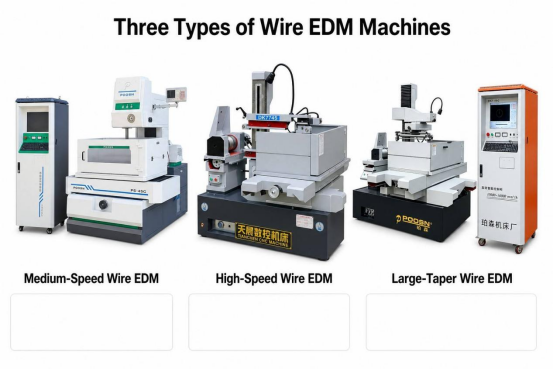
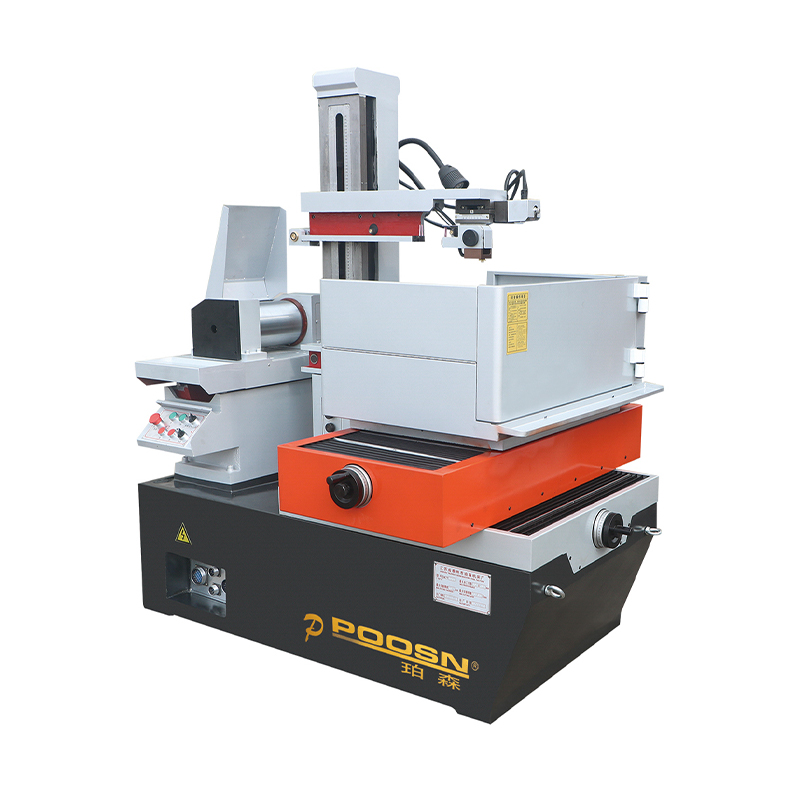
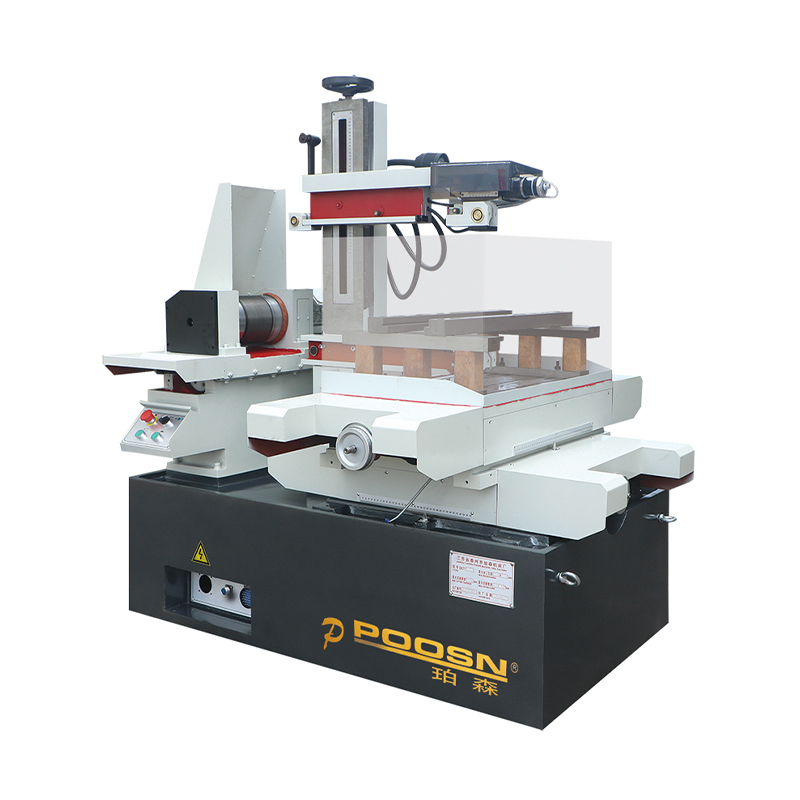
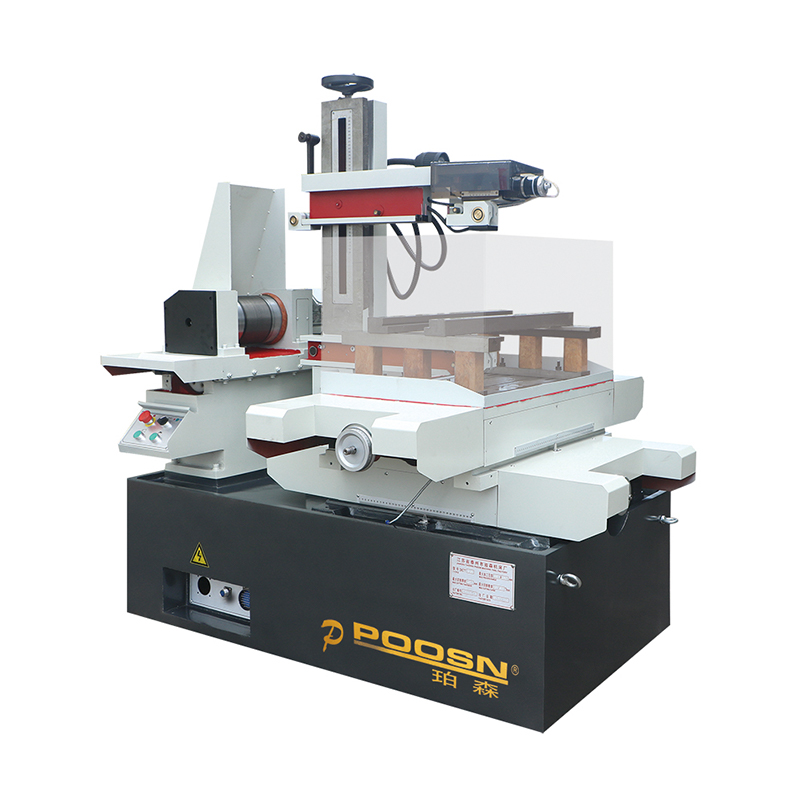
Wire EDM machines are generally grouped by wire speed, wire material, and taper-cutting capability, and these three factors largely determine what a given machine handles well. Medium-speed wire EDM machines run reciprocating molybdenum wire at a controlled, moderate speed and are widely used where a balance of cutting rate and surface finish is needed. High-speed wire EDM machines also typically use reciprocating molybdenum wire but are tuned for faster material removal on straightforward, low-taper profiles. Large-taper wire EDM machines are built around an extended tilt-axis travel range so the wire can be angled through a wide range, which makes them a practical choice for punch-and-die work, extrusion dies, and other parts that need a pronounced draft angle cut into a hardened block.
Because these categories describe a spectrum rather than three rigidly separate designs, many shops end up choosing based on the part families they cut most often rather than a single ideal configuration. The overview below summarizes how each type is typically positioned within a wire EDM machine shop's workflow.
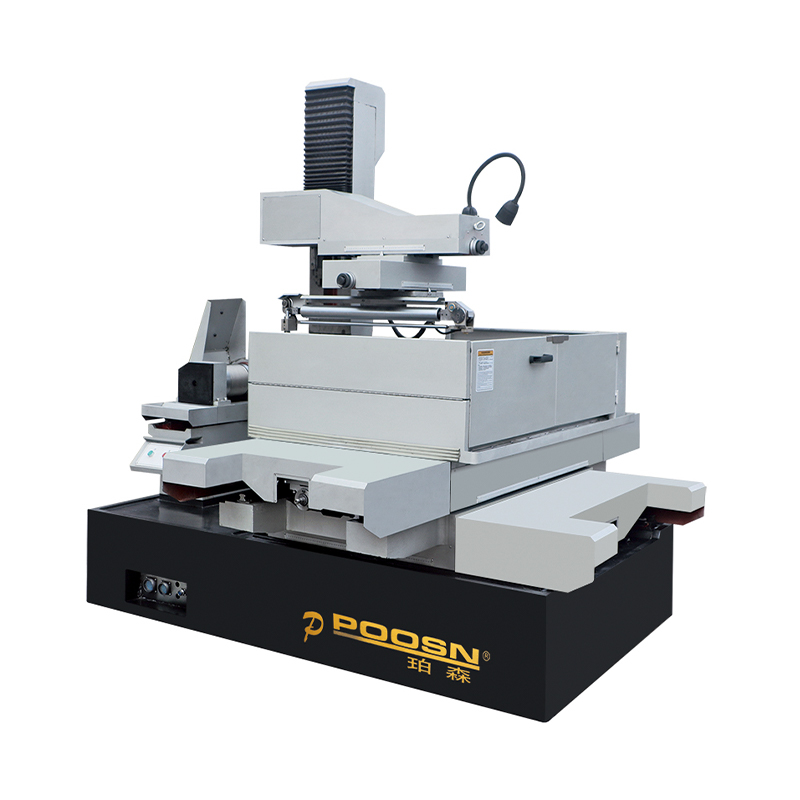
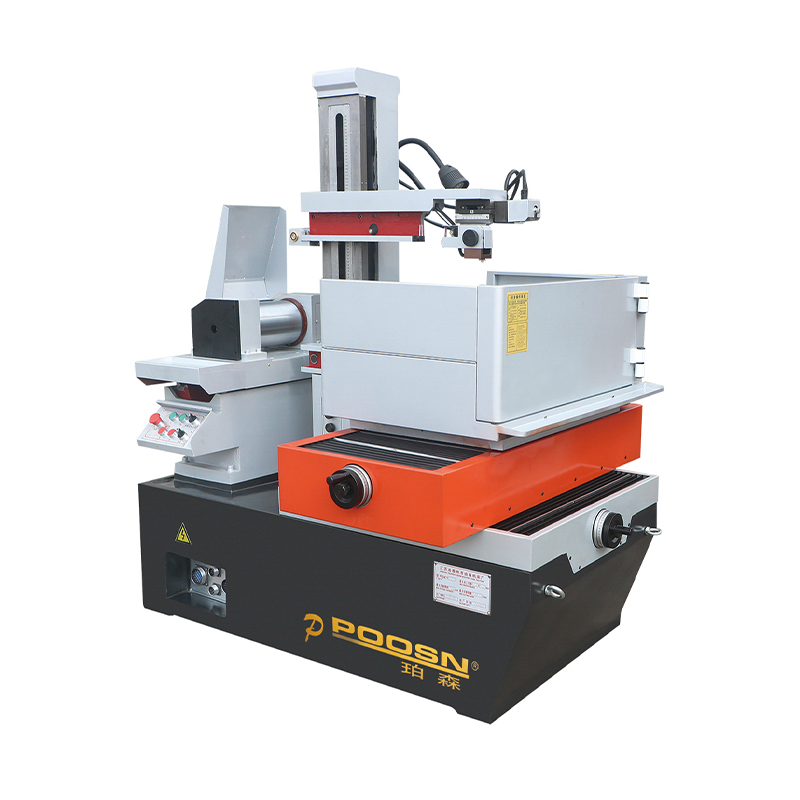
Medium-Speed Wire EDM Reciprocating molybdenum wire, balanced cutting rate and surface finish, common for general tooling and mold components such as the PS-C and DK77-BC series. High-Speed Wire EDM Reciprocating molybdenum wire tuned for faster throughput on lower-taper, higher-volume profile cutting, such as the DK77-A and DK77-B series. Large-Taper Wire EDM Extended tilt-axis travel for pronounced draft angles on punches, dies, and extrusion tooling, such as the DK77-D series.
| Machine Type | Typical Wire | Taper Capability | Typically Used For |
|---|---|---|---|
| Medium-Speed Wire EDM | Molybdenum | Moderate | General mold and tooling components |
| High-Speed Wire EDM | Molybdenum | Low to moderate | Higher-volume, straightforward profiles |
| Large-Taper Wire EDM | Molybdenum or brass | Wide-angle | Punches, dies, and extrusion tooling with draft angles |
Cutting speed is one of the first questions shops ask when comparing wire EDM machine types, since it directly affects cycle time and throughput. Raw speed on its own does not tell the whole story, though, because taper capability and achievable precision often trade off against how fast the wire can travel through the cut. The chart below places medium-speed, high-speed, and large-taper wire EDM machines side by side using a relative efficiency index rather than absolute cutting rates, since actual speed varies with material, thickness, and generator settings. This illustrative index is meant to show the general pattern shops encounter in practice rather than serve as a fixed performance figure for any specific machine. Understanding this pattern helps narrow down which wire EDM machine type is worth evaluating further for a given part family.
As the chart illustrates, high-speed wire EDM machines tend to score highest on the relative cutting efficiency index, which reflects their design focus on rapid material removal for straightforward profiles. Medium-speed wire EDM machines sit close behind, reflecting a design philosophy that balances a reasonably fast cut with steadier wire tension and finer surface control. Large-taper wire EDM machines show the lowest relative index in this comparison, but that does not mean they are a weaker machine overall; it simply reflects that cutting at a pronounced angle inherently slows the process compared to a straight, vertical cut. In practice, a shop cutting simple blanking punches at high volume will usually value the throughput advantage that high-speed wire EDM configurations offer. A shop producing precision mold components with tighter surface finish requirements may lean toward medium-speed wire EDM, where the more controlled wire feed supports a cleaner final pass. A shop that regularly machines dies, extrusion tooling, or punches with draft angles will find that taper capability matters more than raw speed, since without it the part cannot be produced on the machine at all. It is also worth noting that cutting speed on any wire EDM machine changes with workpiece thickness, wire diameter, and the number of trim passes used to hit a target surface finish. Thicker workpieces generally reduce achievable cutting speed regardless of machine type, since more material must be eroded per unit of wire travel. Multiple trim cuts, which are common when a fine surface finish is required, also add total processing time even though they do not change the machine's underlying speed rating. For this reason, the relative index in the chart is best used as a starting point for narrowing down machine type, with a more detailed evaluation of specific part geometry and finish requirements following afterward. Shops that regularly run a mix of straightforward and tapered parts sometimes choose a large-taper wire EDM machine specifically because it can still perform standard vertical cuts, which gives it added flexibility even though its relative efficiency index is lower for tapered work specifically. Matching machine type to the dominant part family in a shop's workload tends to matter more than optimizing purely for the highest cutting speed figure.
Key takeaway: the three main wire EDM machine categories trade off speed, taper capability, and finish control, so the dominant part family a shop cuts should guide the choice more than any single performance figure.
How Wire EDM Machines Work: Working Principle and Core Structure
Every wire EDM machine, regardless of category, removes material through spark erosion: a continuously traveling wire electrode is held a small, controlled distance from the workpiece, and thousands of rapid electrical discharges per second vaporize tiny amounts of metal along the programmed path. The wire itself never physically touches the workpiece, which is why wire cutting EDM can machine hardened tool steel, carbide, and other hard-to-cut materials without the mechanical cutting forces that limit conventional machining.
A dielectric fluid, typically deionized water, flows continuously through the cutting gap. This fluid cools the wire and workpiece, flushes away eroded particles so they do not interfere with subsequent discharges, and helps control the electrical characteristics of the spark gap. A servo control system continuously monitors gap conditions and adjusts wire position in real time to maintain a stable, consistent gap as the cut progresses. Meanwhile, a CNC control drives the X and Y axes to trace the programmed part profile, and on machines built for taper cutting, additional U and V axis motion tilts the wire guides so the wire can cut at an angle rather than strictly vertically.
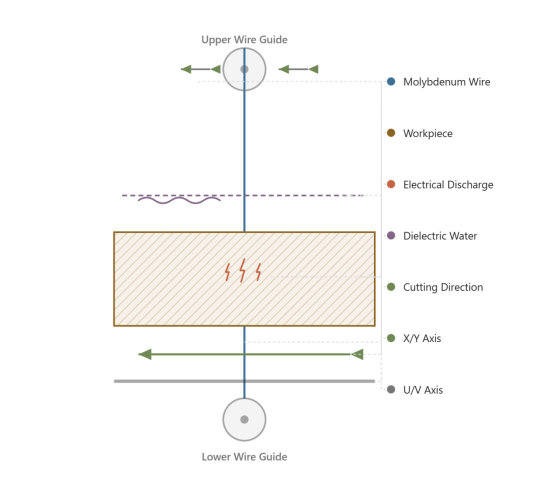
- Wire supply and take-up system, which feeds fresh wire continuously and collects spent wire after it passes through the cut
- Upper and lower wire guides, which position the wire precisely and, on taper-capable machines, tilt to produce angled cuts
- Wire tension control, which keeps the wire taut and stable so it resists deflection during cutting
- Dielectric fluid circulation and filtration system, which supplies clean fluid to the cutting gap and removes eroded debris
- Pulse generator, which produces the electrical discharges that actually erode the material
- CNC control and axis drive system, which positions the worktable and wire guides according to the programmed part geometry
Surface finish is rarely achieved in a single pass on a wire EDM machine, and understanding how finish improves across successive cuts helps explain why multi-pass programming is standard practice. A first, rough cut removes the bulk of the material quickly but leaves a comparatively coarse surface, since the priority at that stage is material removal rather than finish. Subsequent trim cuts use lower energy settings and slower feed rates specifically to reduce surface roughness step by step. The chart below shows a typical, illustrative pattern of how Ra, a common measure of surface roughness, tends to decrease across a rough cut and several trim passes. These values represent general wire EDM process behavior rather than a guaranteed outcome for any specific machine, material, or parameter set.
The line in the chart drops sharply between the rough cut and the first trim cut, which reflects how much of the surface irregularity from rapid, high-energy erosion gets removed in that first finishing pass. Each additional trim cut continues to lower the Ra value, but by progressively smaller amounts, illustrating a pattern of diminishing returns that is common across EDM finishing processes generally. This diminishing-returns pattern is one reason shops weigh the cost of an additional trim pass against how much finish improvement it actually delivers for a given part. Parts destined for further polishing or texturing sometimes stop after two or three passes, since the remaining roughness will be addressed by a separate finishing step anyway. Parts that must meet a tight as-cut surface finish specification, such as certain precision mold cavities, often justify running additional trim passes to reach a lower practical Ra value. Wire diameter, generator settings, and dielectric fluid condition all influence how quickly Ra improves from one pass to the next, so the exact curve will vary from job to job. Machines with steadier wire tension control, often associated with medium-speed wire EDM configurations, tend to produce more consistent finish improvement across passes. Because each trim pass adds processing time, the total number of passes used directly affects cycle time, which is an important planning factor alongside the finish target itself. Shops programming a new part typically start with a known trim sequence from similar prior work and adjust the number of passes based on how the resulting finish measures. Monitoring actual measured Ra values against a pattern like this can help identify when a machine's wire guides, tension system, or flushing may be underperforming, since a flatter-than-expected curve often points to a mechanical or process issue rather than a programming one. Over time, tracking this relationship also supports more accurate quoting, since a shop can estimate cycle time more reliably once it knows roughly how many trim passes a given finish specification will require.
Key takeaway: the wire cutting EDM process relies on a stable spark gap, continuous dielectric flushing, and multi-pass programming, and the same core structure underlies medium-speed, high-speed, and large-taper wire EDM machines alike.
Application Scenarios and Selection Criteria for Wire EDM Equipment
Wire EDM machines serve a wide range of industries, and understanding where the technology is typically applied helps put machine selection decisions in context. Mold and die work has historically been one of the largest application areas for wire EDM, since the process excels at cutting hardened tool steel into precise cavity and punch geometries. Precision tooling, automotive components, and aerospace or medical parts also rely on wire EDM wherever tight tolerances or hard materials make conventional machining difficult. The donut chart below breaks down an illustrative, representative distribution of wire EDM applications across these broad industry segments. As with the earlier chart, these percentages are meant to convey general industry patterns rather than exact market share figures for any specific period or region.
Mold and die applications make up the largest illustrative share in the chart, which aligns with wire EDM's long-standing role in cutting cavities, cores, and inserts from hardened tool steel that would be difficult to machine conventionally. Precision tooling represents the next largest segment, covering items such as gauges, fixtures, and stamping components where tight dimensional tolerances matter more than production volume. Automotive components account for a meaningful share as well, reflecting the industry's ongoing need for durable stamping dies, gears, and precision-fit parts. Aerospace and medical applications, while smaller in overall share, tend to demand some of the tightest tolerances and most demanding material specifications, including nickel-based superalloys and titanium that are difficult to machine by conventional cutting methods. The remaining "other industrial" category captures a broad mix of use cases, from prototype development to specialty electronics housings, that do not fit neatly into the other segments. This distribution also hints at why medium-speed and large-taper wire EDM machines remain popular choices, since mold, die, and tooling work often benefits from the taper capability and finish control these machine types offer. Shops entering a new market segment can use a distribution like this as a rough guide to which capabilities are likely to matter most, though actual demand always depends on the specific customer base a shop serves. A tooling-focused shop, for example, may prioritize taper capability and surface finish over raw cutting speed, given how much of the tooling segment involves complex, close-tolerance geometries. An automotive-focused shop cutting higher volumes of simpler stamping die components may instead prioritize cutting speed and cycle time to keep pace with production schedules. Because wire EDM is a subtractive, non-contact process that does not exert significant mechanical force on the workpiece, it remains an option across all of these segments whenever hardness or geometric complexity rules out conventional cutting methods.
Typical Application Scenarios
|
Key Selection Criteria
|
Key takeaway: matching a wire EDM machine to material thickness, required taper angle, and target surface finish is a more reliable selection approach than choosing based on industry alone.
Detailed Comparison: Medium-Speed vs High-Speed vs Large-Taper Wire EDM
Choosing between medium-speed, high-speed, and large-taper wire EDM machines often comes down to weighing several capabilities at once rather than optimizing for a single metric. Precision, cutting speed, taper capability, automation level, and overall application versatility all factor into which machine type fits a shop's typical workload best. A single-number comparison can be misleading here, since a machine that scores well on speed may score lower on taper capability, and vice versa. The radar chart below places all three machine types across these five dimensions using an illustrative 1-to-10 relative scale, making the trade-offs easier to see at a glance. As with the earlier charts, these values are meant to represent general tendencies across the category rather than the specification sheet of any one specific model.
The radar chart shows that medium-speed wire EDM machines form a relatively balanced shape, scoring reasonably well across precision, automation, and versatility without being the top performer in any single dimension. High-speed wire EDM machines stretch furthest along the speed axis, consistent with their design focus on rapid, high-volume cutting of straightforward profiles. Large-taper wire EDM machines extend furthest along the taper capability axis, reflecting the extended axis travel and tilt range that make wide-angle cutting possible in the first place. Notably, large-taper machines also hold a respectable precision score in this comparison, since taper capability and cutting accuracy are not mutually exclusive in a well-built machine. The versatility axis tends to favor medium-speed and large-taper configurations slightly more than high-speed machines, since the ability to handle both straight and tapered work broadens the range of parts a single machine can produce. Automation scores are fairly close across all three types in this illustrative comparison, reflecting how automatic wire threading, programmable tension control, and CNC positioning have become common features across modern wire EDM machines generally rather than being unique to one category. Shops that primarily cut straight-walled tooling components in high volume will likely find that the high-speed machine's advantage on the speed axis outweighs its lower taper score. Shops producing punches, dies, or extrusion tooling with draft angles will place more weight on the taper capability axis, where large-taper machines clearly lead. Shops with a mixed workload, cutting both straightforward and tapered parts across different jobs, often gravitate toward the more balanced profile shown by medium-speed wire EDM machines. Reading a radar chart like this is less about picking the single largest shape and more about matching the shape's strongest axes to the specific requirements of a shop's typical parts. Because these values are illustrative rather than measured from a specific model, shops evaluating a purchase should confirm actual precision, speed, and taper specifications directly with the equipment manufacturer for the model under consideration.
| Criterion | Medium-Speed Wire EDM | High-Speed Wire EDM | Large-Taper Wire EDM |
|---|---|---|---|
| Wire electrode | Molybdenum, reciprocating | Molybdenum, reciprocating | Molybdenum or brass |
| Taper range | Moderate | Low to moderate | Wide-angle |
| Surface finish potential | Strong with multi-pass trimming | Good, secondary to speed | Good on tapered and straight cuts |
| Cutting speed tendency | Moderate | Higher on simple profiles | Lower on complex taper work |
| Common applications | General mold and tooling parts | High-volume straightforward profiles | Punches, dies, extrusion tooling |
Key takeaway: no single wire EDM category leads on every dimension, so shops with a mixed workload often benefit from evaluating precision, speed, taper range, and automation together rather than any one factor alone.
Maintenance Guidelines for Wire EDM Machines
Consistent maintenance keeps a wire EDM machine cutting to its designed accuracy over years of use, and most of the routine tasks are straightforward once built into a regular schedule. Wire tension should be checked and calibrated periodically, since a wire that runs too loose or too tight can affect straightness and, in turn, part accuracy. Dielectric fluid quality, typically measured through water resistivity, needs regular monitoring along with timely filter replacement, since contaminated or poorly conditioned fluid slows cutting and can increase wire breakage. Wire guides wear gradually from constant contact with the traveling wire and should be inspected on a set interval and replaced once wear affects cut straightness. The dielectric tank, worktable, and wire path should be cleaned regularly to prevent debris buildup from interfering with flushing and electrical contact.
Additional Practices That Support Long-Term Accuracy
- Periodically verify machine leveling and axis positioning accuracy against a known reference
- Keep an inventory of key consumables, including wire, filters, and wire guides, to avoid unplanned downtime
- Inspect and lubricate guide rails and ball screws according to the manufacturer's recommended interval
- Record recurring issues, such as unexpected wire breakage, so patterns can be traced back to a root cause
| Task | Suggested Frequency | Purpose |
|---|---|---|
| Dielectric fluid resistivity check | Daily | Maintain stable spark gap conditions |
| Filter inspection and replacement | Weekly, or as indicated | Keep dielectric fluid free of debris |
| Wire guide inspection | Monthly | Preserve wire straightness and cut accuracy |
| Tank and worktable cleaning | Weekly | Prevent debris interference with flushing |
| Positioning accuracy verification | Quarterly or per shop policy | Confirm axis positioning remains within tolerance |
Key takeaway: dielectric fluid condition, wire guide wear, and periodic positioning checks are the maintenance factors most closely tied to a wire EDM machine's long-term cutting accuracy.
About POOSN – Professional Wire EDM Machine Manufacturer
About POOSN – Professional Wire EDM Machine Manufacturer
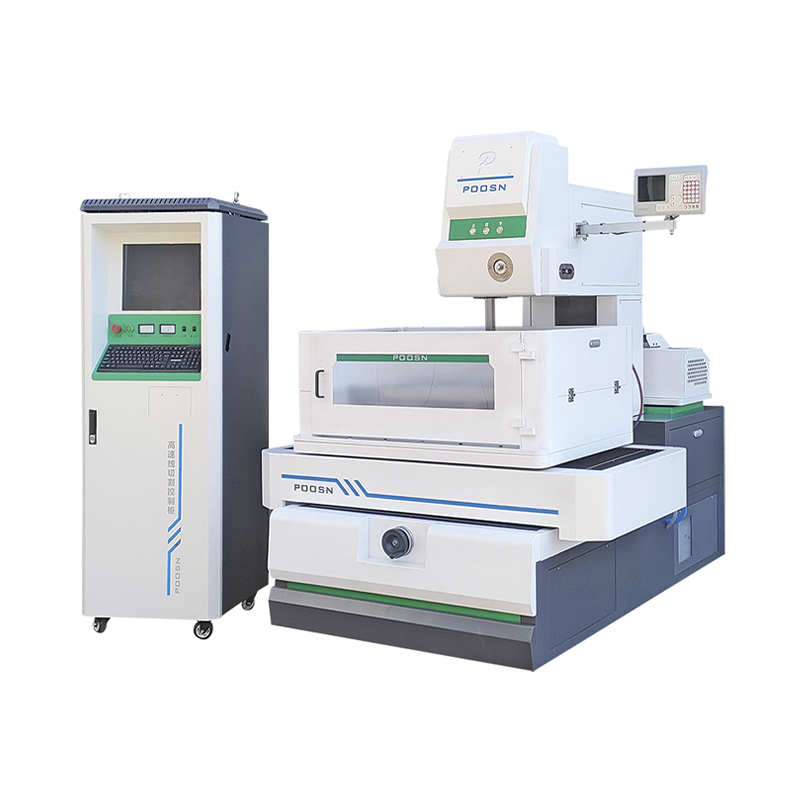
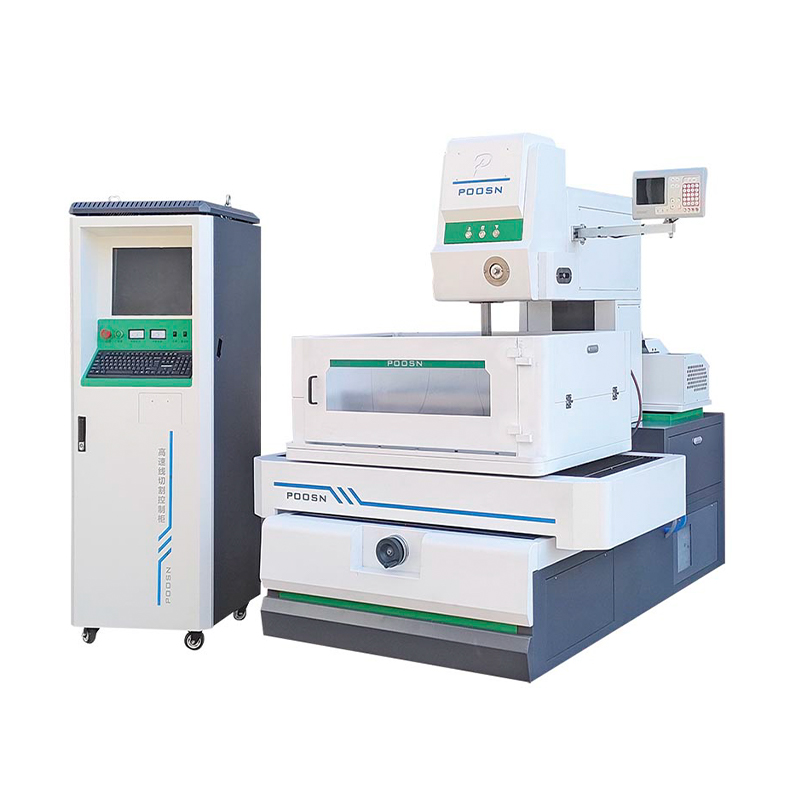
Taizhou Xinchengyang Machinery Manufacturing Co., Ltd is one example of a manufacturer structured around this kind of product breadth. The company focuses on the research, development, and production of electrical discharge machining equipment and related special processing technology, with a product range that spans the PS-C and DK77-BC medium-speed wire EDM series, the DK77-A and DK77-B high-speed wire EDM series, and the DK77-D large-taper wire EDM series. Each machine tool is tested for positioning accuracy as part of production, a step that is directly relevant to the axis-positioning maintenance checks discussed above, since a machine's starting accuracy sets the baseline that ongoing maintenance is meant to preserve. The company's products are sold across domestic markets, with select models exported to Southeast Asia, West Asia, Europe, and the Americas, which reflects the kind of documentation and after-sales communication that international wire EDM equipment buyers typically look for when comparing suppliers. This breadth of experience, paired with a stated focus on quality and customer needs, illustrates the general profile shops should look for when evaluating any wire EDM machine manufacturer, whether or not that specific supplier is the one ultimately chosen.
Key takeaway:Choosing the right Wire EDM machine depends on your workpiece material, thickness, required accuracy, taper angle and production volume. If you are not sure which machine is suitable for your application, contact POOSN and share your workpiece specifications. Our team can help you select a suitable Wire EDM solution.
Frequently Asked Questions About Wire EDM Machines
Q1: What is the difference between wire EDM and sinker EDM?Wire EDM uses a continuously traveling thin wire as the electrode to cut a through-profile in the workpiece, similar in concept to an extremely precise band saw guided by electrical discharges. Sinker EDM instead uses a shaped electrode that is pressed into the workpiece to form a cavity matching the electrode's shape. Wire EDM is generally chosen for through-cutting profiles, while sinker EDM is chosen for blind cavities and complex internal geometries. |
Q2: What materials can be cut with a wire EDM machine?Wire EDM can cut any electrically conductive material regardless of hardness, including hardened tool steel, tungsten carbide, and various superalloys. Because the process removes material through electrical discharge rather than mechanical cutting force, material hardness that would challenge conventional tooling does not prevent wire EDM from producing an accurate cut. |
Q3: How does medium-speed wire EDM differ from high-speed wire EDM?Both configurations typically use reciprocating molybdenum wire, but medium-speed wire EDM machines are tuned toward steadier wire tension and finer surface control, while high-speed wire EDM machines are tuned toward faster material removal on straightforward, lower-taper profiles. The right choice depends on whether a shop's typical parts prioritize finish or throughput. |
Q4: When is a large-taper wire EDM machine necessary?A large-taper wire EDM machine becomes necessary whenever a part requires a pronounced draft angle cut through a hardened section, such as punches, dies, and extrusion tooling. Standard medium-speed or high-speed configurations offer only moderate taper range, so parts requiring a wide-angle cut typically need the extended axis travel found on large-taper machines. |
Q5: How often should a wire EDM machine be maintained?Some tasks, such as checking dielectric fluid resistivity, are best done daily, while others, such as filter changes and tank cleaning, are typically weekly tasks. Wire guide inspection is commonly handled on a monthly basis, and positioning accuracy verification is often scheduled quarterly or according to a shop's own internal policy. |
-
Телефон
+86-0523-86268788 +86-13815960366 +86-13912191163Эл. почта
[email protected]Адрес
Китай, г. Тайчжоу, р-н Хайлин, пос. Цзюлун, ул. Юйшэн, д. 366
